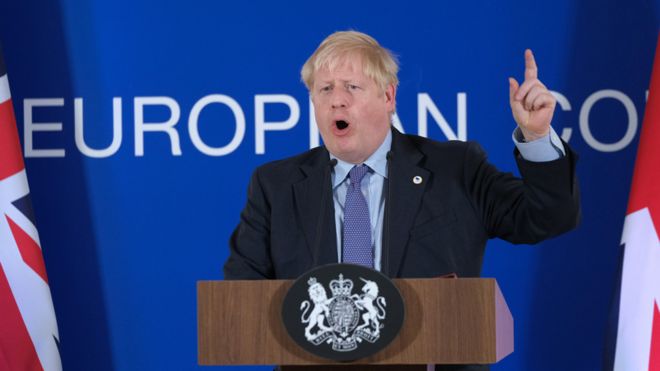
Image copyrightGETTY IMAGESImage captionEU leaders and Boris Johnson agreed on a revised UK Brexit deal in October
Over and over again in this election campaign you hear supporters of Boris Johnson confidently asserting that "he did it with the Brexit deal: he got the EU to renegotiate when most people said it'd be impossible.
"So who cares about those who now openly doubt his ability to get a trade deal done with the EU by December next year? The doubters were wrong before. They'll be proved wrong again."
Except, it seems to be overlooked that Prime Minister Johnson did not charm or bully or manipulate the EU into reopening the Brexit Withdrawal Agreement and changing the infamous backstop for the Irish border.
It was only by breaking a deep red line of his, very late on in the negotiations, that EU leaders wholeheartedly agreed to a "new" Brexit deal (that in reality was almost identical to the one negotiated by Theresa May).
If you remember, Mr Johnson had pledged never to allow a post-Brexit division between Northern Ireland and the rest of the UK.
But in the end that is exactly what he did.
Different rules for Northern Ireland
While on paper and in legal terms Mr Johnson has ensured that Northern Ireland would leave the EU's customs union and single market along with Great Britain, practically speaking Northern Ireland would continue adhering to the EU's customs code and being part of the EU's single market for goods.
Boris Johnson's divorce deal introduces a customs barrier down the Irish Sea. A barrier between Northern Ireland and the rest of the UK. Something Mr Johnson had said he would never countenance.
EU leaders negotiated with Boris Johnson in the hope that he would better be able to sell a deal back home in the UK than his predecessor, Mrs May. But they only signed on the dotted line of the backstop's replacement because they were confident that it protected their single market on the island of Ireland after Brexit.
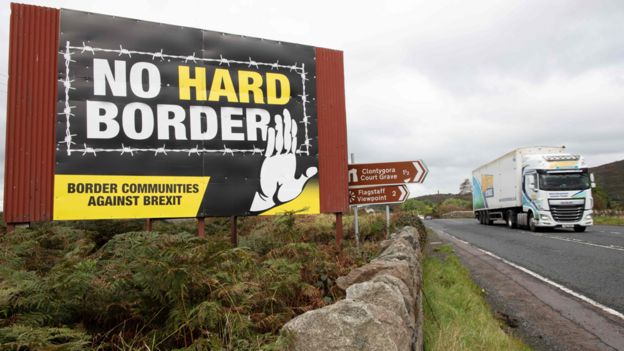
Image copyrightAFPImage captionThe border at Newry: A majority in Northern Ireland voted to remain in the EU
For the prime minister, "getting it done" seemed of greater importance when it came to the Brexit deal than keeping his word about the union and avoiding a line down the Irish Sea. So how might it be when it comes to trade negotiations?
Deal deadline pressure
Would Boris Johnson give up post-Brexit "sovereignty" and "control" to get a quick deal done with the EU by next Christmas?
Because if you earwig on EU internal conversations these days, you'll hear that the only way he has a real chance of getting a bare-bones free trade agreement (FTA) with Brussels done and dusted by next Christmas is if he crosses his own red lines again and gives in to EU concerns. This time over so-called level playing field provisions (such as adhering to EU environmental, labour and state aid rules after Brexit) and allowing EU countries fishing rights in UK waters.
If Mr Johnson signs up to ongoing alignment with EU rules, then where's the national sovereignty he promised voters?
But if he doesn't, then trade negotiations with Brussels are likely to drag on a lot, lot longer. And could delay closing trade deals with other countries. Japan, Canada, Australia and others are unlikely to want to sign off on a new trade deal with a post-Brexit UK until they know what kind of relationship it will have with the EU.
Something else to bear in mind: if Boris Johnson did maintain close ties with the EU, then Brexit-associated divisions between Northern Ireland and Great Britain would diminish; Brussels would have less need for checks, controls and paperwork to closely monitor what is coming in or going out of its single market/customs territory via the island of Ireland.
It all comes down to not being able to have your cake and eat it.
Those trade-offs - which so many politicians seem very reluctant to come clean about this election season.
Image copyrightEPAImage caption(L-R): Ukraine's Volodymyr Zelensky, France's Emmanuel Macron, Russia's Vladimir Putin and Germany's Angela Merkel at the Élysée Palace in Paris
Ukraine and Russia have agreed to implement a "full and comprehensive" ceasefire in eastern Ukraine by the end of 2019, after top-level talks.
Russian President Vladimir Putin and Ukraine's Volodymyr Zelensky met face to face in Paris on Monday.
Five-and-a-half years of fighting between Ukrainian government forces and Russian-backed rebels have cost 13,000 lives.
The negotiations were brokered by the leaders of France and Germany.
They follow a big prisoner swap and the withdrawal of Ukraine's military from three key areas on the front line.
In a written statement, the countries agreed to the release and exchange of all "conflict-related detainees" by the end of the year.
The two sides also pledged to disengage military forces in three additional regions of Ukraine by the end of March 2020, without specifying which regions would be affected.
Additional talks will be held in four month to take stock of the ceasefire's progress.
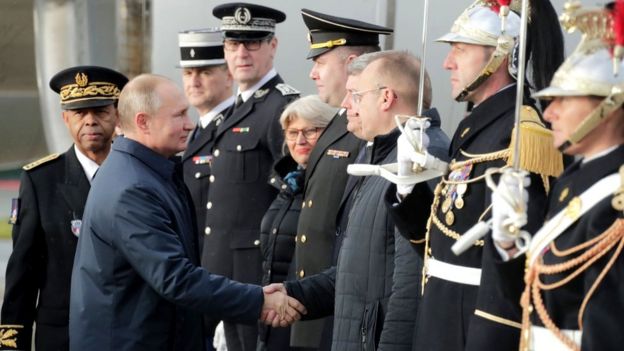
Image copyrightGETTY IMAGESImage captionVladimir Putin arrives for talks in Paris aimed at tackling the conflict in eastern Ukraine
At a press conference after the talks in France's Élysée Palace, President Putin hailed the talks as an "important step" towards a de-escalation of the conflict.
President Zelensky said the issue of Russian gas exports via pipelines through Ukraine had been "unblocked" after a dispute about transit tariffs, and an agreement would now be worked out.
But Russia and Ukraine continue to disagree on issues such as the withdrawal of Russia-back troops, and elections in areas of Ukraine held by separatist rebels.
Mr Putin also called for a change in Ukraine's constitution to give special status to the Donbas region, which is held by the rebels.
Ukraine's President Zelensky also told reporters that Ukraine would not make any territorial concessions in exchange for peace.
"We saw differences today," said French President Emmanuel Macron, who hosted the talks with German Chancellor Angela Merkel.
"We didn't find the miracle solution, but we have advanced on it," he added.
So how did we get here?
Mr Zelensky, a former comic actor, was elected president of Ukraine in a landslide victory in April following a campaign built around bringing peace to eastern Ukraine.
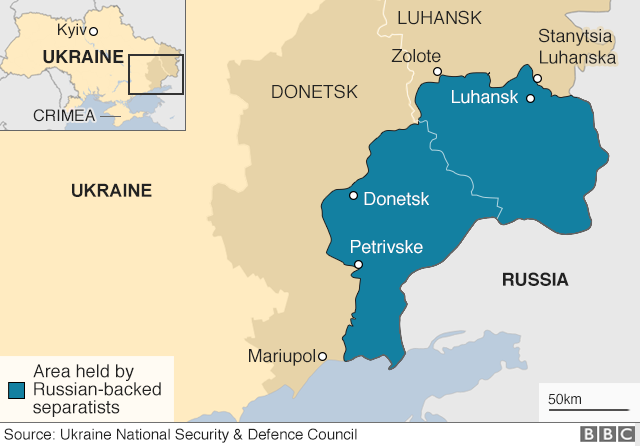
Since then, his strategy has focused on trying to restart talks with Moscow. For that to happen Mr Zelensky has had to agree to some Russian conditions, including pulling back Ukrainian troops in the eastern towns of Stanytsia Luhansk, Petrivske, and Zolote.
In June, Ukrainian troops and pro-Russian separatists withdrew a kilometre from Stanytsia Luhanska. By late October, the Ukrainians and separatists had disengaged from Zolote and early in November they pulled back from Petrivske.
Nato and Western intelligence experts have repeatedly accused Russia of sending heavy weapons and combat troops into eastern Ukraine to help the rebels.
Russia denies that, but admits that Russian "volunteers" are helping the rebels.
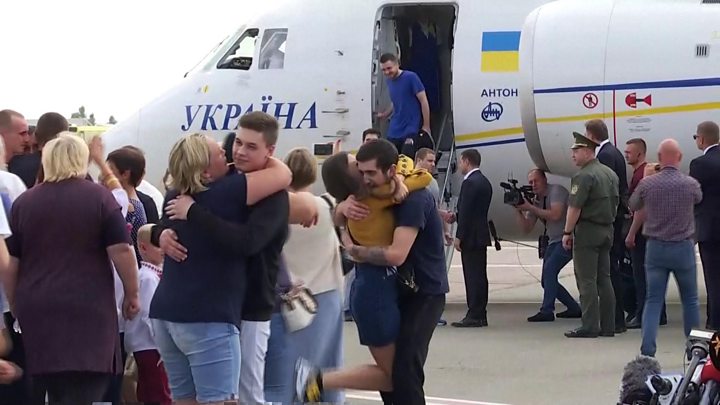
In September, Mr Zelensky won praise for a long-awaited prisoner swap with Russia - he described it as a "victory" that had emerged from personal phone contact with the Russian president.
Media captionFreed Ukrainians meet families after months of separation
The "Steinmeier formula" aims to break the impasse over peace agreements reached at the height of the fighting. It details free and fair elections in the east under Ukrainian law, verification by the Organisation for Security and Co-operation in Europe (OSCE), and then self-governing status in return.
What triggered the deadly conflict?
Pro-Russian separatists seized control of large swathes of Donetsk and Luhansk regions in April 2014, just after Russia's annexation of Ukraine's Crimea peninsula.
It was an insurgency against the new pro-Western authorities in the capital Kyiv, who had ousted the pro-Russian President, Viktor Yanukovych, in street protests dubbed the "Maidan Revolution".
The separatists later declared independence from Ukraine - but no country has recognised their "republics".
March, 2014: Russian forces annex Crimea after President Yanukovych is ousted in Kyiv, prompting the biggest East-West showdown since the Cold War. The US and the EU impose harsh sanctions on Russia
April: Pro-Russian armed groups seize parts of the Donetsk and Luhansk regions on the Russian border of eastern Ukraine. Ukraine launches a military operation in response
September: Nato confirms Russian troops and heavy military equipment have been entering eastern Ukraine
November, 2018: Three Ukrainian ships are intercepted by Russia in the Kerch Strait near Crimea. Ukraine calls it an act of Russian aggression, saying the Black Sea is free for shipping
April-July, 2019: Volodymyr Zelensky wins presidential election run-off in a landslide victory over incumbent Petro Poroshenko

 GETTY IMAGES
 AFP
AFP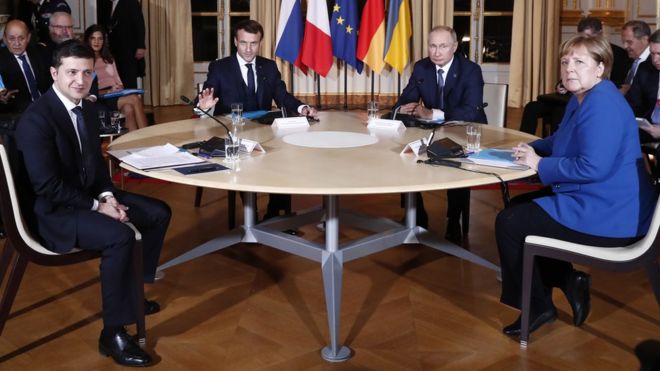 EPA
EPA
 GETTY IMAGES